


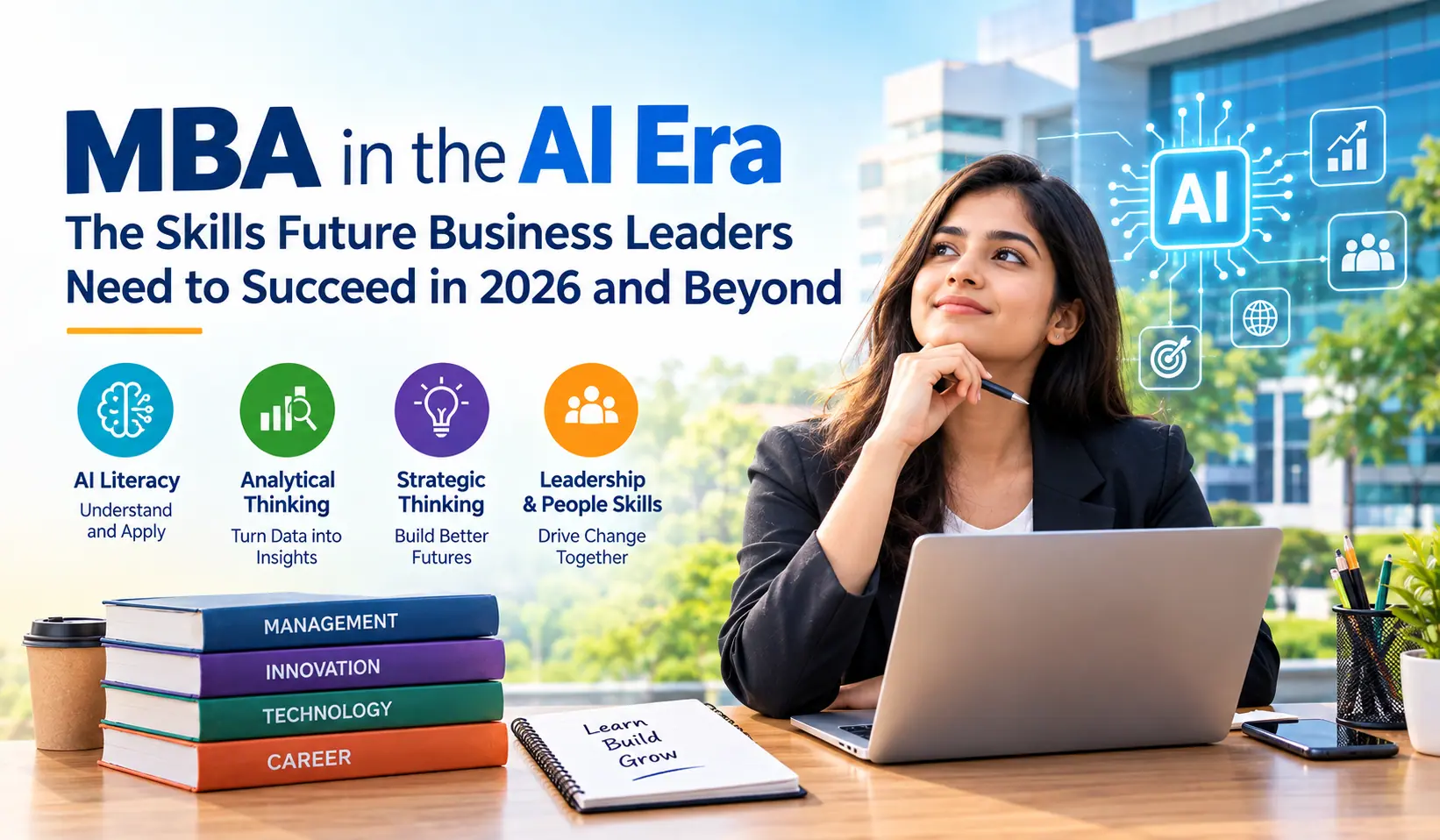
MBA in the AI Era The Skills Future Business Leaders Need to Succeed in 2026 and Beyond
Artificial intelligence is no longer a subject reserved for technology teams. It is becoming part of everyday business.
Marketing teams use AI to understand audiences and accelerate content creation. Finance professionals use intelligent systems to analyse large volumes of information. HR teams are adopting AI-assisted recruitment and workforce analytics. Operations leaders use predictive tools to improve planning, while senior management increasingly relies on data-driven systems to support strategic decisions.
For MBA students entering the workforce in 2026, this shift changes an important question. It is no longer enough to ask, “Do I understand business?” Future managers also need to ask, “Can I lead, decide and create value in a business environment increasingly shaped by AI?”
That does not mean every MBA graduate needs to become a programmer or machine-learning engineer. It means tomorrow’s managers must understand what AI can do, where it creates value, where it introduces risk and how it should be used responsibly. The future belongs to business professionals who can combine management judgement, analytical ability, technological awareness and human leadership skills.
AI Is Changing Management, Not Eliminating It
Much of the early conversation around artificial intelligence focused on automation. Which jobs would disappear? Which tasks could machines perform? How quickly could organisations reduce manual work? The discussion is now becoming more sophisticated.
AI can automate repetitive tasks, generate reports, identify patterns and assist decision-making. But businesses still need people who can determine which problems are worth solving, interpret results, manage teams, understand customers and take responsibility for decisions.
The World Economic Forum’s Future of Jobs Report 2025 reflects this combination: AI and big data rank among the fastest-growing skills, while analytical thinking remains the most widely cited core skill among employers. Leadership, resilience, creative thinking, technological literacy and lifelong learning also matter. Becoming more technologically capable makes good management more demanding.
1. AI Literacy Will Become a Basic Management Skill
A manager does not need to know how to build a large language model. But a manager increasingly needs to understand what such systems can and cannot do. AI literacy involves knowing how artificial intelligence can be applied to business problems, how to evaluate its output and when human intervention is necessary.
Consider a marketing manager using AI to analyse customer behaviour. The software may identify patterns and recommend which customers are most likely to purchase. But the manager still needs to ask: Is the underlying data reliable? Does the recommendation make commercial sense? Could the model introduce bias? Does the campaign respect customer privacy? What happens if the prediction is wrong?
Those are managerial questions. Technology may produce information. Leadership determines how it is used. MBA graduates who understand AI at a practical business level can make better decisions than those who ignore it or rely on it unquestioningly.
2. Analytical Thinking Will Matter More, Not Less
When managers have access to more data, dashboards and automated recommendations, they also have more information to evaluate. Distinguishing useful insight from noise becomes crucial. The World Economic Forum reports that analytical thinking remains employers’ most important core skill, while AI and big data are among those growing fastest in importance.
A future-ready MBA student should become comfortable working with numbers. That does not require advanced mathematics. It means knowing how to read business data, identify patterns, question assumptions and connect numbers with commercial reality.
If sales decline by 12%, a manager should investigate rather than merely report it. Is demand falling? Has customer acquisition become more expensive? Did a competitor enter the market? Is there a distribution problem? Has pricing changed? Is the decline concentrated in one product or region? AI may accelerate the analysis. A manager still needs to frame the right question.
3. Strategic Thinking Will Separate Managers from Tool Users
Technology can help organisations execute faster. Strategy determines whether they are moving in the right direction. If two competitors can access similar AI tools, advantage comes from how intelligently they apply them.
Future business leaders need to understand market positioning, customer behaviour, competition, organisational capabilities, finance and long-term business consequences. They must also understand when not to use technology. Sometimes the most sophisticated solution is not the most practical. A successful manager balances innovation with cost, risk, customer experience and organisational readiness.
4. Data Storytelling Will Become an Essential Leadership Ability
Senior executives rarely make decisions based on raw spreadsheets alone. They need someone to explain what the numbers mean. Imagine a business analyst identifying an unexpected decline in customer retention. Producing the chart is only the first step. A strong manager explains what changed, why it matters, what may be causing it, what to investigate and what decision should follow.
This is where analytical ability and communication meet. Students pursuing an MBA in 2026 should learn spreadsheets, dashboards, visualisation tools and analytics platforms, as well as how to communicate findings in clear business language. The best analysis has limited value if decision-makers cannot understand it.
5. Leadership Will Become More Human in an AI-Driven Workplace
People still want clarity and feedback. Teams still experience disagreement, uncertainty, stress and ambition. Customers still respond to empathy and trust. Organisations still depend on culture. The World Economic Forum identifies leadership and social influence among skills expected to increase in importance towards 2030.
For MBA students, leadership development should extend beyond textbooks. Students should practise leading teams, presenting ideas, resolving disagreements, negotiating, listening and receiving feedback. Leadership is learned partly through knowledge, but largely through experience.
6. Communication Skills Will Remain a Career Multiplier
AI can write an email. Effective business communication still requires an understanding of audience, context and objective. A presentation to investors differs from a conversation with employees. A sales pitch calls for a different approach from a boardroom strategy discussion.
A manager may need to translate technical information for customers, executives or colleagues. MBA graduates increasingly work alongside engineers, designers, data scientists, marketers, finance professionals and technology teams. People who communicate across those boundaries become valuable connectors inside organisations.
7. Managers Need to Understand AI Ethics and Governance
Companies cannot deploy powerful technology and ignore the consequences. AI systems may interact with sensitive employee information, customer behaviour, financial data or confidential business information. They may also produce incorrect or biased recommendations.
Managers need basic awareness of data privacy, information security, algorithmic bias, intellectual property, transparency, responsible AI use and regulatory compliance. If a manager authorises an AI-driven business process, that manager needs to understand its risks. Future leaders must be willing to ask difficult questions before approving technology simply because it appears innovative.
8. Creativity Will Become More Valuable as Routine Work Becomes Easier
Generative AI can produce dozens of ideas within seconds. If everyone has access to the same tools, generic ideas become easier to produce. Businesses still need people capable of identifying opportunities others have missed.
A creative manager may discover a new customer segment, develop an unconventional partnership, reposition a product or redesign an inefficient process. The World Economic Forum lists creative thinking among skills expected to increase in importance. MBA students should use AI to explore possibilities, then think beyond the output.
9. Continuous Learning Is Becoming a Professional Requirement
An MBA qualification provides a career foundation, but cannot supply every skill someone will need for the next 30 years. Technology changes too quickly. The World Economic Forum estimates that approximately 39% of workers’ existing skill sets could be transformed or become outdated between 2025 and 2030.
Managers entering the workforce today should expect to repeatedly learn new technologies, regulations, business models and ways of working. They may move between industries, take roles that do not yet exist, and manage teams containing both people and sophisticated AI systems. Effective MBA education should build curiosity as well as knowledge.
10. Internships and Live Projects Will Matter More
AI can help students understand concepts. It cannot completely reproduce the experience of working inside an organisation. Internships, live projects and industry exposure remain important. Deloitte India’s Campus Workforce Trends 2026 reports a move towards more skills-focused campus recruitment, with internships increasingly used as indicators of future performance and pathways to pre-placement offers.
Practical exposure lets MBA students encounter problems with no perfectly structured answer. A company may have incomplete data. A client may change a requirement. A campaign may underperform. Team members may disagree. A budget may be reduced. Learning to operate in these conditions develops professional maturity.
At Dr. D. Y. Patil Institute of Management and Entrepreneur Development (DYPIMED), Pune, On-the-Job Training is an integral component of the MBA programme, with students undertaking industry exposure after Semester II to apply classroom knowledge in practical business environments.
11. Learn to Collaborate With Technology Teams
A marketing manager may work with data analysts. A finance professional may collaborate with automation specialists. An HR manager may help implement an AI recruitment platform. An operations manager may work alongside software teams developing predictive systems.
Management students benefit from learning enough technology vocabulary to participate meaningfully in these conversations. They need to understand business requirements clearly enough to translate them into problems technical teams can solve. Connecting business objectives with technology execution may become one of the defining capabilities of future managers.
12. Build Commercial Awareness
Businesses need to create value. A manager should understand how an organisation earns revenue, controls costs, acquires customers, competes and generates sustainable returns. When evaluating an AI initiative, ask not only “Can we build this?” but also “Should we build this?”
What problem does it solve? Who benefits? How much does implementation cost? Does it reduce expenses or generate revenue? Can the organisation maintain it? What risks does it introduce? This business-first mindset separates technology enthusiasm from management thinking.
What Should MBA Students Learn in 2026?
Business fundamentals: marketing, finance, human resources, operations, economics, strategy and entrepreneurship. Technology works best when applied to genuine business understanding.
Analytical capabilities: Excel and spreadsheets, business analytics, data interpretation, dashboards, financial analysis, forecasting and basic statistics.
Digital and AI capabilities: generative AI, AI-assisted productivity, business applications of machine learning, automation, digital transformation, data privacy and responsible AI.
Human capabilities: communication, negotiation, leadership, emotional intelligence, teamwork, critical thinking and adaptability.
The strongest managers connect all four categories.
The Changing Role of MBA Education
Management programmes need to reflect how companies actually operate. Students need conceptual knowledge and opportunities to apply it. The MBA programme at DYPIMED focuses on analytical thinking, leadership and practical business skills. Its curriculum includes Business Analytics, Decision Science, Technology Tools in Business Management, Operations and Supply Chain Management, and Entrepreneurship, Innovation & Design Thinking.
DYPIMED describes its Training and Placement Cell as combining academics with corporate exposure, skill development, live projects, management activities and mentorship. For students, access to these opportunities is only the beginning. The greatest benefit comes from participation.
Do Not Compete With AI. Learn to Lead With It.
What kind of manager will become more valuable because AI exists? One who understands technology without accepting every recommendation unquestioningly; who understands data without forgetting customers; who automates routine work while strengthening relationships; who makes faster decisions without becoming careless; and who continues learning after earning a degree. AI is a powerful business tool, but leadership still requires responsibility.
Final Thoughts
The MBA of the future will be defined by adaptability. Today’s students may begin their careers using technologies that did not exist when today’s senior executives entered the workforce. Ten years from now, they will probably use tools that have not yet been invented. That uncertainty makes strong fundamentals more important.
Understand business. Learn how technology creates value. Become comfortable with data. Communicate clearly. Practise leadership. Develop ethical judgement. Gain real-world experience. Keep learning. Artificial intelligence may change how businesses operate, but organisations will continue to need people capable of deciding where to go, why it matters and how to bring others with them.
